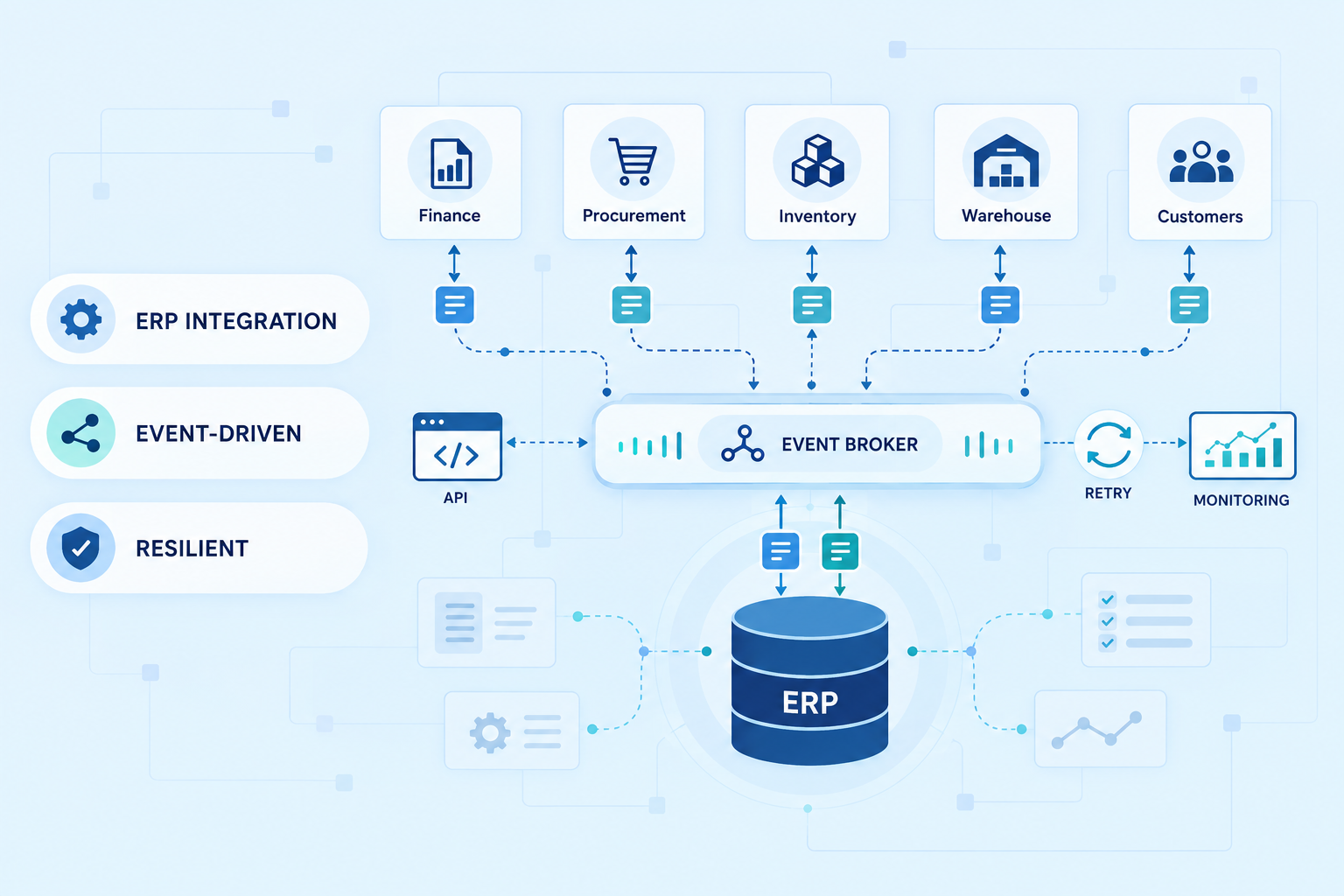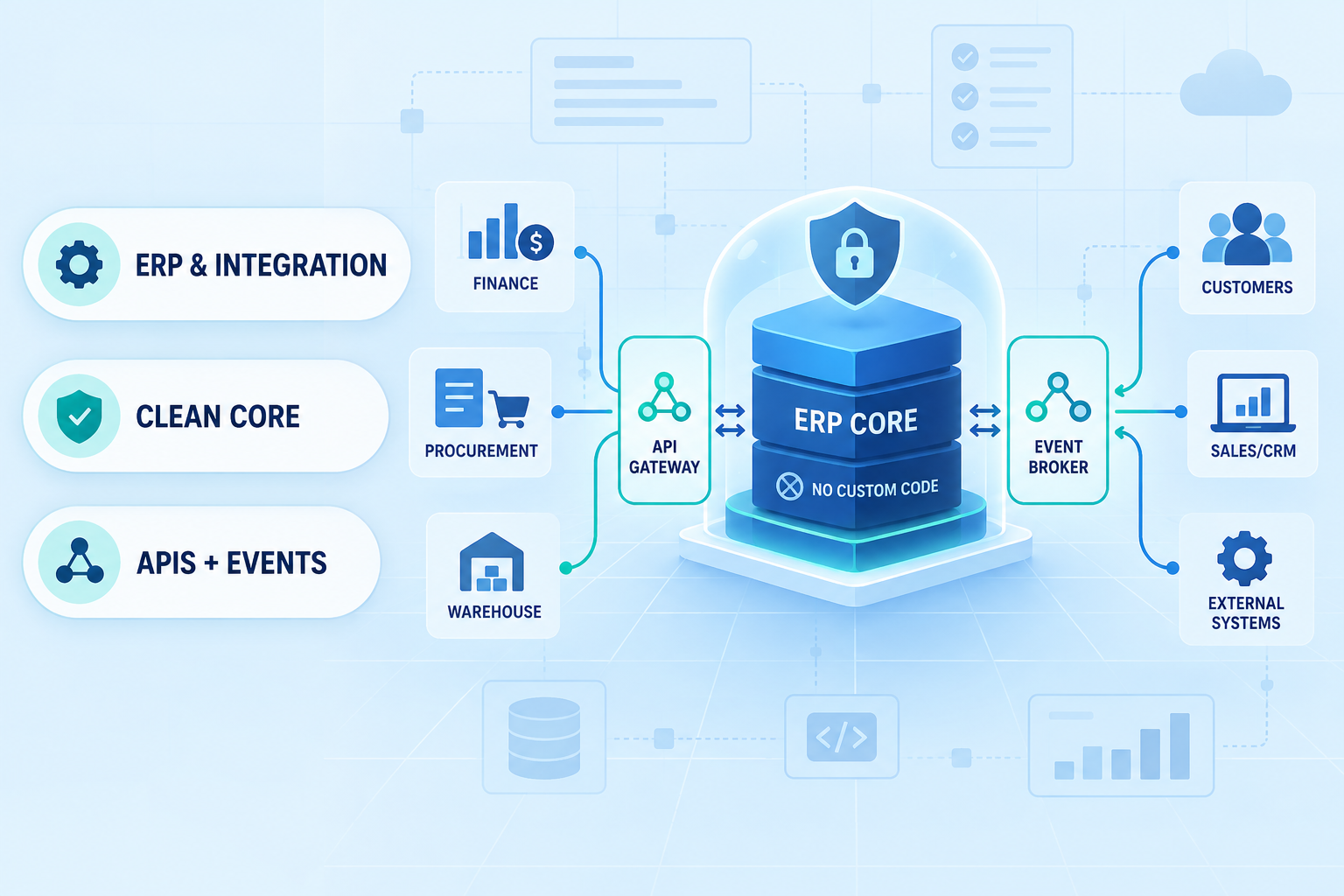

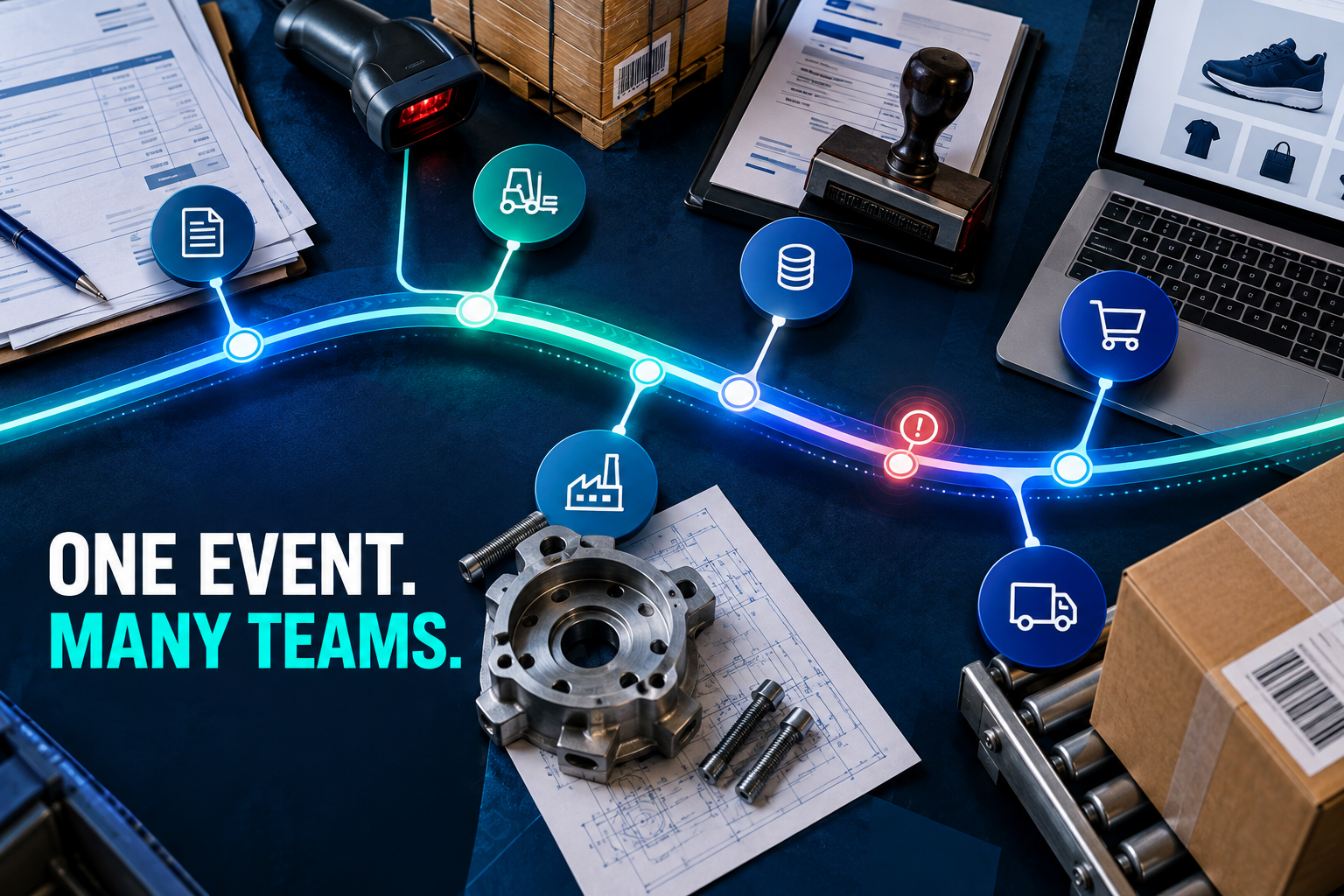
An ERP event rarely belongs to one team. An order release may affect warehouse allocation, production, transport, customer notifications, analytics, and finance. Point-to-point integrations make the first connection easy and the tenth dangerous: every producer knows too much about consumers, changes require coordinated deployments, and failures hide between systems.
AWS announced an enhanced EventBridge custom event bus on September 24 for enterprise-scale event-driven applications. AWS documentation describes retained events, ordered delivery, subscribers that can start from a past position, pause and resume, filtering, transformation, and cross-account sharing. These capabilities support a shared backbone, but governance determines whether it becomes leverage or another integration monolith.
Publish business facts, not database noise
Events should describe stable facts such as OrderReleased, ShipmentDispatched, QualityHoldPlaced, or InvoicePosted. Include event ID, version, time, producer, correlation ID, and the minimum domain payload consumers need. Do not broadcast entire ERP tables or sensitive fields because it feels future-proof.
Assign an owner to every event contract. Document semantics, ordering boundary, retention, privacy classification, and compatibility rules. A schema registry or contract repository helps, but ownership and review make it effective.
Keep producers independent
The producer confirms its own transaction, then emits the resulting fact through a reliable outbox or equivalent pattern. It should not know which warehouse, data platform, or notification system subscribes. New consumers can join without changing ERP code.
This decoupling does not make the bus the system of record. ERP remains authoritative for its domain. Consumers build their own state and must reconcile when they fall behind or receive corrections.
Use ordering at the right granularity
Global ordering reduces throughput and rarely matches business need. Preserve order for one sales order, shipment, batch, or asset through an event-group key. Consumers must still handle duplicate delivery and late business corrections. Use stable IDs and idempotent writes.
The new custom bus can retain events and let subscribers begin from a position in the past. Define how far replay may go, whether side effects are suppressed during rebuild, and how a consumer proves it has caught up.
Subscribers need operational contracts
One subscriber selects events and delivers to one target; fan-out uses separate subscribers. Filters reduce noise, while transformations can adapt payloads. Test filters against real events, because a syntactically valid pattern can match nothing. Keep transformations simple and observable.
Configure retries and a dead-letter queue. AWS documentation notes a default retry policy and supports an on-failure queue. Assign ownership for that queue, alert on age and depth, and provide a safe redrive process. A dead-letter queue nobody reviews is delayed data loss.
A factory-to-ERP example
MES publishes ProductionQuantityConfirmed with order, operation, quantity, unit, batch, and event ID. Inventory subscribes and posts stock idempotently. Planning updates progress. Analytics consumes the same fact. Quality sees only events relevant to held or released material.
IoT readings do not flow directly into ERP. Plant systems interpret sensor and machine evidence, then publish governed production facts. If AI detects an anomaly, it can recommend inspection; an approved workflow publishes the resulting hold or maintenance event. This protects business semantics and human oversight.
Secure the shared backbone
Cross-account sharing should use explicit resource policies, least-privilege publish and subscribe rights, encryption, and separate environments. Restrict who can create broad subscribers. Log contract changes, access changes, replay requests, and transformations.
Do not place secrets or unnecessary personal data in events. Retention increases utility and exposure, so align it with recovery, audit, and privacy requirements. Test revocation and compromised-producer scenarios.
Avoid the enterprise dumping ground
Define domains and naming rules. A single organizational bus may be convenient, but some boundaries deserve separate buses for ownership, regulation, blast radius, or volume. Set quotas and cost allocation. Monitor publish failures, delivery latency, filter matches, drops, DLQ delivery, and consumer lag.
Create a platform team that provides templates, observability, security, and support—not one that owns every business mapping. Domain teams should own event meaning and consumer behavior.
Adopt incrementally
Choose one high-friction fan-out flow. Baseline manual reconciliation, integration failures, change lead time, and recovery effort. Implement the event contract, two consumers, replay, and failure handling. Break permissions and targets intentionally. Verify that business reconciliation closes the loop.
A shared event backbone can reduce integration cost and speed change, but only when events remain meaningful, subscribers remain accountable, and replay is safe. The objective is not one giant bus. It is one reliable fact that many teams can use without tightly coupling their systems.
Turn the idea into an accountable rollout
Before funding a production rollout, name the business owner, technical owner, security reviewer, support team, and the person authorized to stop or reverse the change. Record the baseline process, its current cost or delay, and the outcome the project is expected to improve. A useful target is measurable without pretending that every benefit can be guaranteed in advance.
Deliver in a bounded slice with representative data and real users. Test normal operation, peak demand, dependency failure, permission loss, duplicate input, recovery, and rollback. Document what continues when the new capability is unavailable. Train the people who will handle exceptions rather than only the team building the happy path.
After launch, review reliability, unit cost, user adoption, false alerts or exceptions, support effort, and realized process improvement. Keep a decision log for threshold and configuration changes. Expand only when evidence shows that the operating model is sustainable. This discipline turns an appealing technology announcement into a service the organization can trust, support, and improve.
Sources
- AWS News Blog — enhanced custom event bus announcement
- AWS documentation — EventBridge Custom Event Bus
Build it with Cogniquaint experts
Cogniquaint’s ERP, cloud, and integration experts can identify high-value event flows, define governed contracts, implement outbox and subscriber patterns, secure cross-account delivery, and build replay, reconciliation, and observability into the platform from day one.
Work with Cogniquaint
Ready to elevate your operations with AI-powered insights?
Get in touch with us to build your next intelligent solution.