

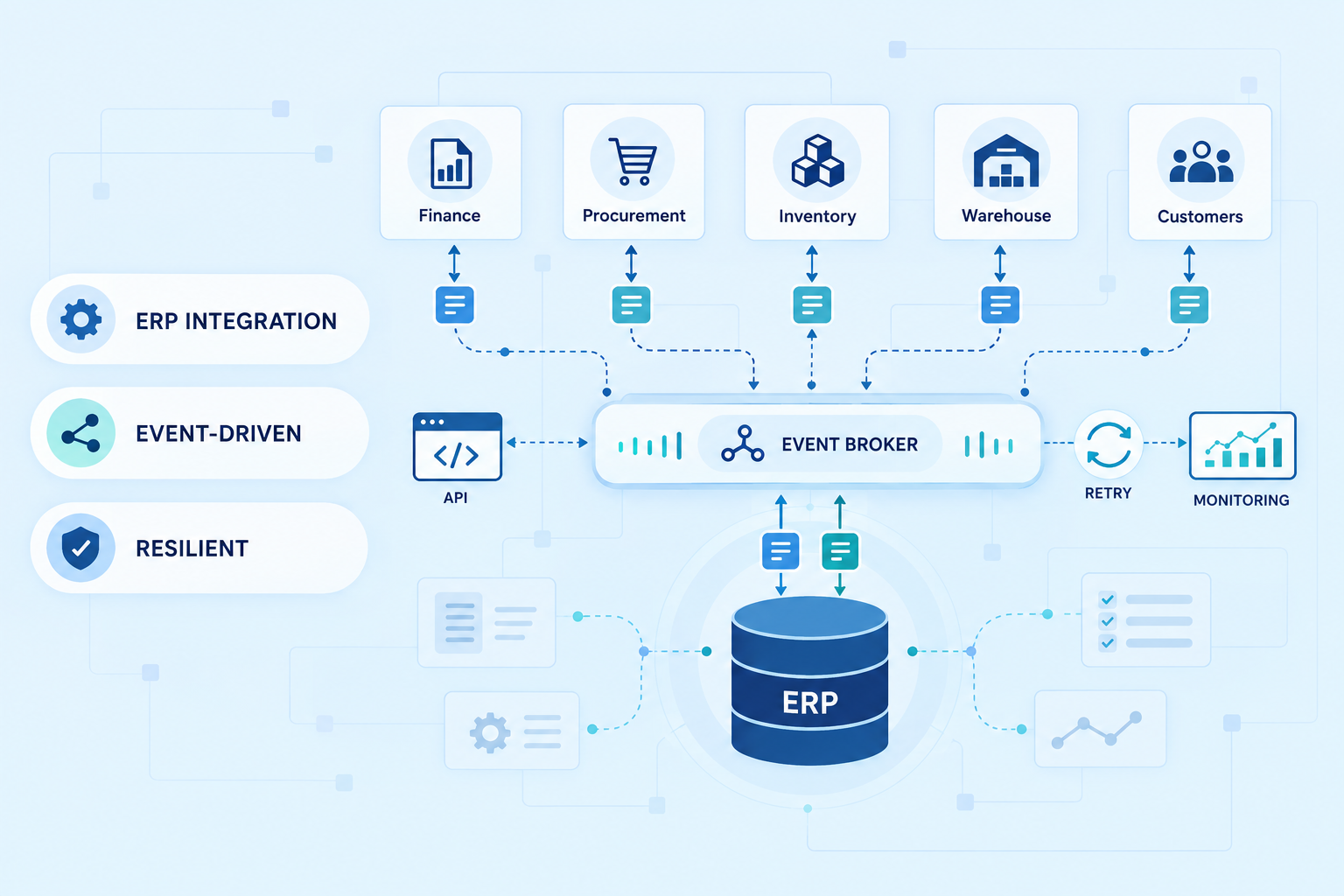
ERP platforms sit at the center of finance, procurement, inventory, manufacturing, and workforce processes. Integrating them is unavoidable; coupling every system directly to the ERP is not. Point-to-point interfaces accumulate quickly, make upgrades risky, and turn small data changes into cross-application incidents.
Event-driven architecture can reduce that coupling by publishing meaningful business changes for independent consumers. It is not a replacement for APIs, batch transfer, or workflow orchestration. A durable ERP integration landscape uses each style for the problem it solves best.
Begin with the business interaction
Choose the integration style from the business requirement, not from a preferred product. A user checking current credit availability may need a synchronous API response. A confirmed sales order can emit an event for fulfillment, analytics, and notifications. A nightly transfer may remain suitable for a large, non-urgent reconciliation file. A multi-step approval process needs orchestration and explicit state.
Classify every interaction by latency, volume, consistency, direction, sensitivity, failure tolerance, and ownership. This prevents “real time” from becoming a vague requirement that adds distributed-system complexity without measurable benefit.
Events should describe facts
A business event records something that has happened: PurchaseOrderApproved, GoodsReceived, CustomerCreditChanged. Consumers decide what to do with that fact. An event should not be a disguised remote command such as “UpdateSystemBNow,” because that binds the producer to a specific consumer and recreates point-to-point coupling through a broker.
Define a stable event envelope with an identifier, type, version, source, timestamp, correlation identifier, and relevant business key. Keep the payload focused. Sensitive information should be excluded unless consumers require it and the channel is governed accordingly.
Use APIs and events together
Events are effective for notification and fan-out, but consumers often need additional information. Publish enough data for routing and common decisions, then let authorized consumers use a governed API to retrieve the current record when necessary. This reduces large payloads and limits unnecessary replication of regulated data.
APIs also remain appropriate for commands that require immediate validation. A procurement application might call an ERP API to submit a requisition and receive an acceptance response. The ERP can later publish status events as approval, ordering, receipt, and invoicing progress.
Design for at-least-once delivery
Distributed messaging commonly favors reliable at-least-once delivery, which means a consumer may receive the same event more than once. Consumers must be idempotent. Store processed event identifiers, use safe upsert operations, and protect irreversible actions such as payments or external notifications with a business idempotency key.
Ordering should be scoped narrowly. Global ordering restricts throughput and is rarely necessary. If sequence matters for a purchase order, partition by that order’s identifier and define how consumers handle missing or late events.
Protect the transaction boundary
A classic failure occurs when the ERP transaction commits but event publication fails, or the event is published before the transaction rolls back. Use a transactional outbox or an equivalent platform capability: write the business change and an event record in the same transaction, then publish the event asynchronously. Consumers should assume eventual consistency and expose processing state where users need visibility.
For long-running processes across systems, use choreography only when the flow remains understandable. Complex approvals, compensations, and timeouts often benefit from an orchestrator that owns process state. Avoid distributed transactions across cloud services; model compensation and recovery explicitly.
Make failure a first-class path
Retry only transient failures and use exponential backoff with jitter. Invalid or repeatedly failing messages should move to a dead-letter queue with the original event, failure reason, attempt count, and trace context. Define who owns that queue and the time allowed to resolve it.
Replay is valuable but dangerous. A replayed historical event can trigger a current customer email or duplicate a financial action. Provide replay controls by event type, time range, consumer, and dry-run mode. Record every replay as an auditable operation.
Version contracts independently
ERP upgrades and SaaS releases should not require coordinated changes across every consumer. Maintain event schemas and API contracts in a catalog, identify owners, and automate compatibility checks. Prefer additive evolution. When a breaking change is unavoidable, run versions in parallel for a defined migration period and measure remaining consumers before retirement.
Keep custom code out of the ERP core where possible. Model-driven extensions, published APIs, events, and integration services preserve upgradeability better than source-level modifications. The objective is not zero customization; it is a governed extension surface that survives platform updates.
Build observability around business outcomes
Infrastructure metrics alone cannot answer whether an order reached fulfillment. Propagate correlation identifiers across the ERP, broker, orchestration layer, APIs, and consumers. Track event age, processing latency, retry counts, dead-letter volume, consumer lag, and completion of the business milestone.
Create operational views in business language: orders awaiting warehouse acknowledgement, invoices blocked by validation, or supplier updates delayed beyond the service objective. This lets process owners participate in recovery without reading broker dashboards.
Adopt incrementally
Select one event with multiple consumers and a clear business benefit. Document the current flow, define the contract, implement idempotency and tracing, and run the new path alongside the existing interface. Test duplicates, delayed delivery, malformed payloads, unavailable consumers, replay, and ERP upgrade scenarios.
After proving the pattern, standardize the event envelope, schema review, security model, deployment templates, dashboards, and support ownership. A shared integration platform should reduce the cost of the next interface rather than centralize every change in one team.
The takeaway
Event-driven ERP integration succeeds when events represent stable business facts and the operating model embraces eventual consistency, duplicate delivery, recovery, versioning, and traceability. Combine events with APIs, orchestration, and batch transfer based on the interaction. The reward is not simply faster data movement; it is an integration estate that can evolve without making the ERP core—and every connected system—fragile.
Sources
- Microsoft Azure Architecture Center: Event-driven architecture style
- Microsoft Azure Architecture Center: Integration architecture design
- Microsoft Azure Architecture Center: Dynamics 365 SaaS architecture journey
Build it with Cogniquaint experts
Cogniquaint partners with enterprise application and integration teams to modernize complex ERP landscapes without destabilizing the core. Our in-house experts help define API and event contracts, design resilient integration flows, implement observability and replay controls, and create a phased roadmap aligned with business operations.
Work with Cogniquaint
Ready to elevate your operations with AI-powered insights?
Get in touch with us to build your next intelligent solution.
