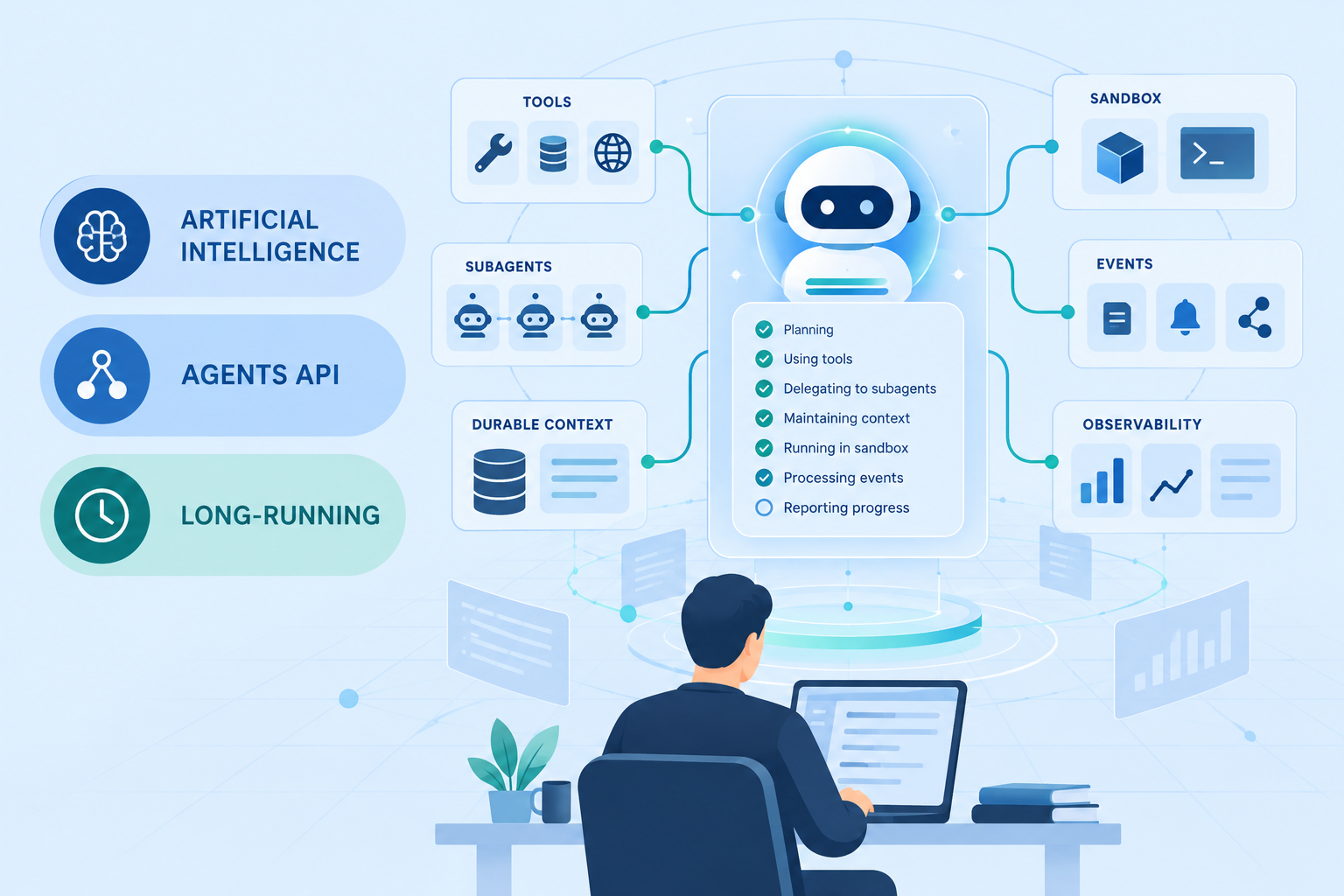


An AI agent can produce an acceptable final answer while quietly retrying the same search, calling an expensive tool unnecessarily, waiting on a slow dependency, or missing evidence that happened not to affect this case. Output review alone cannot show that behavior. Claude Platform now documents native OpenTelemetry tracing for Messages API requests, tool uses, and Managed Agents sessions; Databricks has announced native ingestion into MLflow as one supported destination.
OpenTelemetry gives teams a vendor-neutral record of the path through an application. A trace contains spans for steps such as model requests and tools, with timing, status, token usage, and—when explicitly enabled—prompt and response content.
Trace a complete business request
Propagate one trace context from the user or system event through retrieval, model calls, custom tools, APIs, databases, and the final action. Add stable metadata such as application version, agent version, environment, tenant class, feature, and outcome. Avoid putting personal or secret values in tags that are widely indexed.
Begin with metadata-only collection
Anthropic makes metadata-only the default and offers a full-content mode. Full content can make diagnosis and evaluation far easier, but prompts, documents, tool arguments, and results may contain customer records, credentials, source code, or confidential business context. Define approved content classes, redaction, access, retention, regional handling, and incident response before enabling it.
Turn traces into operational questions
Measure time to first useful result, total latency, tokens, tool calls, errors, retries, loop depth, and cost per successful outcome. Look for repeated successful calls with identical inputs, tools that return oversized context, slow dependencies, and agent versions that increase effort without improving quality. A lower token count is not success if task completion falls.
Join machine evidence with expert review
Send representative failed, expensive, and high-impact traces to domain reviewers. Ask whether the answer was correct, evidence was sufficient, required steps were followed, and the resulting action was appropriate. Capture expected responses and failure labels. This turns production behavior into a controlled evaluation set.
Compare changes on the same cases
A prompt or tool fix can solve one trace and regress another. Replay a fixed cohort against the current and candidate versions. Evaluate accuracy, policy compliance, tool efficiency, latency, cost, and variation across runs. Promote only when a named owner accepts the trade-off.
Keep observability from becoming surveillance
Collect the minimum needed for reliability and safety. Separate engineering telemetry from employee performance measurement. Inform users where required, restrict raw-content access, audit queries, and expire traces according to purpose.
The takeaway: traces make an agent explainable as a system, not as a mind. They show what happened, where time and money went, and which change actually improved behavior—provided the trace data itself is treated as sensitive production information.
From announcement to dependable operations
Start with a bounded business problem and an accountable owner. Record the current cost, delay, failure rate, and manual work before changing the architecture. Define a measurable outcome, but do not present an estimate as guaranteed savings. Include security, finance, operations, and the people who will support exceptions after launch.
Map the current workflow before selecting technology. Identify the source of truth, approval points, downstream consumers, sensitive data, recovery objectives, and every manual workaround. Decide which step the new capability improves and which steps remain unchanged. This prevents a demonstration from being mistaken for an end-to-end operating solution.
Build a representative pilot with real permissions, data volume, dependency behavior, and user roles. Test peak demand, missing data, stale configuration, denied access, duplicate input, partial failure, recovery, and rollback. Document what continues when the new capability is unavailable. Keep an approved manual path for high-consequence decisions.
Security must be part of the design. Use separate workload identities, short-lived credentials, least privilege, encrypted transport and storage, controlled secrets, and auditable administrative access. Treat retrieved documents, event payloads, model output, and third-party responses as untrusted input. Validate every action at the boundary where it affects money, data, equipment, customers, or regulated records.
Cost controls need similar depth. Tag usage to a product and owner, define budgets and anomaly thresholds, measure cost per successful business outcome, and include integration, support, data movement, licensing, and training. A lower infrastructure bill can be offset by more exceptions or human correction. Evaluate total process cost rather than one service price.
Operate the result like a product. Monitor availability, latency, unit cost, data quality, security findings, user adoption, exceptions, and support effort. Version configurations and decision rules. Log changes and approvals. Review whether the capability still solves the original problem as prices, products, and workflows evolve.
Prepare the support model before launch. Give responders dashboards, runbooks, ownership, escalation paths, and safe diagnostic access. Alert on stale data and silent degradation, not only complete failure. Practice a dependency outage and verify that queued work, retries, reconciliation, and user communication behave as designed.
Change management is also technical risk control. Explain what users should trust, what they must verify, and how they report a wrong result. Train with real scenarios and capture overrides as useful feedback. Do not measure adoption by logins alone; measure whether the process becomes faster, safer, or more accurate.
Maintain a decision record that states why the technology was selected, which alternatives were considered, which risks were accepted, and what would trigger redesign or retirement. Review it after incidents and major vendor changes. Portability does not require avoiding managed services; it requires knowing which data, contracts, identities, and operational procedures must survive a change.
Expansion should follow evidence. Compare the pilot with its baseline, include the cost of integration and governance, and retire components that no longer earn their complexity. A new feature creates value only when teams can understand it, control it, recover it, and improve it without depending on one specialist.
Finally, schedule a formal review after thirty and ninety days. Ask whether users changed behavior, whether exceptions moved elsewhere, and whether actual costs match the forecast. Publish the findings to sponsors and delivery teams. If value is weak, narrow the scope or stop. Responsible innovation includes the ability to end an experiment cleanly.
Sources
- Claude Platform — OpenTelemetry tracing for the Claude API
- Databricks — Native Claude OpenTelemetry observability in MLflow
Build it with Cogniquaint experts
Cogniquaint’s AI and platform experts can instrument end-to-end agent traces, design privacy-aware collection, connect trace evidence with expert review, build cost and quality evaluations, and operationalize alerting and promotion gates across AI applications.
Work with Cogniquaint
Ready to elevate your operations with AI-powered insights?
Get in touch with us to build your next intelligent solution.