

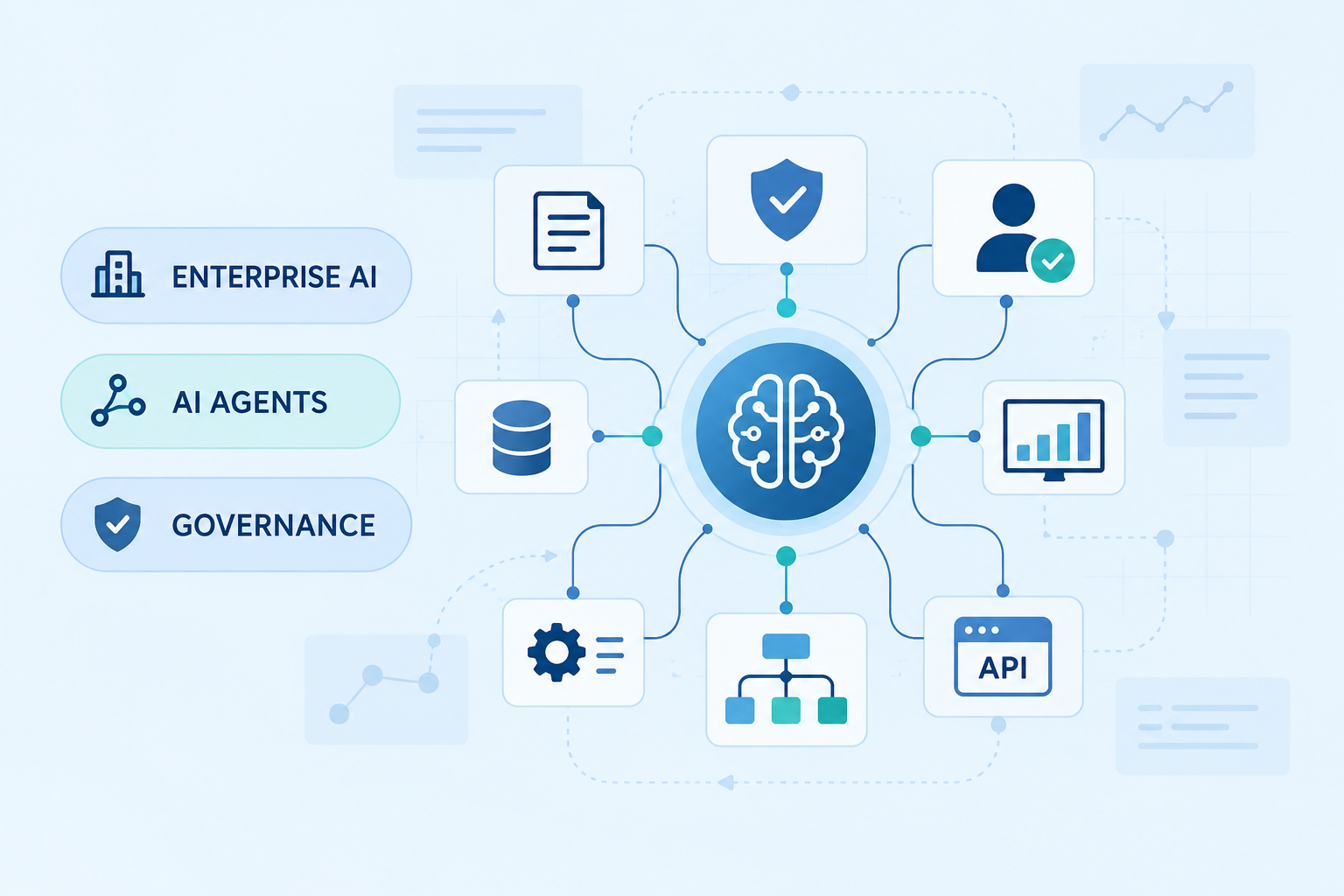
AI agents are attractive because they can plan, use tools, and complete multi-step work rather than simply return text. That same autonomy changes the risk profile. A chatbot answer can be reviewed and ignored; an agent may update a CRM record, initiate a workflow, query sensitive systems, or communicate with a customer. Production success therefore depends as much on the operating model as on the model.
The right starting point is a bounded workflow with a clear owner, measurable outcome, and explicit authority. The wrong starting point is an open-ended mandate to “automate operations.” Enterprises should treat an agent as a software-operated role: define what it may see, what it may decide, what it may change, and when it must stop.
Choose workflows with genuine agent value
Agents are most useful when work involves judgment, unstructured information, and a sequence of actions that cannot be captured economically in fixed rules. Examples include triaging service cases, assembling evidence for a compliance review, or investigating a data-quality incident across several systems.
A conventional workflow remains preferable when rules are stable and deterministic. If a process can be expressed as a small decision table, adding an agent may increase cost and uncertainty without creating value. Evaluate candidate workflows using business impact, task ambiguity, reversibility, data sensitivity, and the cost of an incorrect action.
Start with one agent and a small toolset
Complex multi-agent designs can look sophisticated while making production behavior harder to trace. Begin with a single orchestrating agent and a limited collection of well-documented tools. Split responsibilities only when evaluation data shows that specialization improves reliability or maintainability.
Each tool should have a narrow purpose, typed inputs, predictable outputs, and explicit error behavior. The agent should not receive a generic database credential or unrestricted shell access when a purpose-built “get order status” or “create draft ticket” operation is sufficient. Tools are the agent’s authority boundary, so their design is a security decision.
Separate reading, proposing, and acting
A useful control pattern divides capabilities into three levels. Read operations retrieve information without changing external state. Proposal operations generate a recommended action for review. Action operations make a change in another system. Teams can allow broader autonomy for reading, require evidence for proposals, and apply approval or policy checks before actions.
Reversibility should influence the approval threshold. Updating an internal draft is different from issuing a refund, changing access rights, or sending a public statement. High-impact actions should have deterministic validation, strong identity controls, and a human decision where the residual risk remains material.
Build evaluations around the workflow
Generic model benchmarks do not tell you whether an agent can safely perform your process. Create an evaluation set from real, sanitized cases, including normal tasks, ambiguous requests, missing data, malicious instructions, unavailable tools, and conflicting records.
Measure more than final-answer quality. Track task completion, factual grounding, tool-selection accuracy, unauthorized action attempts, escalation quality, latency, and cost. For workflows with side effects, run evaluations in a sandbox or with simulated tools. A successful test should prove that the agent knows when not to act.
Use a risk lifecycle, not a launch checklist
NIST’s Generative AI Profile organizes risk work across governance, mapping, measurement, and management. That lifecycle is useful for agents because their environment changes after launch: models are updated, tool APIs evolve, business policies change, and adversarial techniques improve.
Governance assigns accountability and acceptable-use boundaries. Mapping documents the workflow, stakeholders, data, dependencies, and plausible harms. Measurement turns those risks into tests and monitoring. Management prioritizes mitigations, incident response, and decisions about whether the use case should continue.
Make observability understandable
Production teams need a trace of the agent’s decisions without exposing unnecessary sensitive reasoning or data. Record the request identifier, model and policy versions, tools invoked, sanitized inputs and outputs, approvals, errors, latency, and final outcome. Link the trace to the business transaction so incidents can be reconstructed.
Operational dashboards should show escalation rates, repeated attempts, tool failures, policy blocks, user corrections, and outcome quality. Rising token usage may signal a prompt problem, but it may also reveal a tool returning excessive context or an agent stuck in a retry loop.
Design the human handoff
“Human in the loop” is not a complete design. Specify who receives the case, what evidence accompanies it, how quickly they must respond, and what happens while the decision is pending. The agent should provide a concise summary, source records, attempted actions, and the precise decision required.
Users must also know when they are interacting with an automated system and how to challenge or correct an outcome. Corrections should feed the evaluation backlog rather than disappear into support conversations.
A production readiness gate
Before granting an agent write access, confirm that the use case has an accountable owner, a defined success metric, versioned instructions, least-privilege tools, workflow-specific evaluations, an approval policy, complete operational tracing, rate and spend limits, incident procedures, and a tested kill switch. Deploy gradually, beginning with observation or draft mode before enabling autonomous actions.
The takeaway
Enterprise agents become dependable through constrained authority, measurable workflows, and continuous risk management. Better prompts help, but they cannot substitute for tool design, identity boundaries, evaluations, monitoring, and ownership. Treat the agent as an operational capability with a clear job description, not as a general-purpose intelligence dropped into the organization.
Sources
- OpenAI: A practical guide to building AI agents
- NIST: Generative AI Profile for the AI Risk Management Framework
Build it with Cogniquaint experts
Cogniquaint works side by side with product, engineering, risk, and operations teams to move AI agents beyond demonstrations. Our in-house experts help identify valuable workflows, build secure tool boundaries, create evaluation suites, design human approvals, and establish the production controls needed for dependable adoption.
Work with Cogniquaint
Ready to elevate your operations with AI-powered insights?
Get in touch with us to build your next intelligent solution.
