

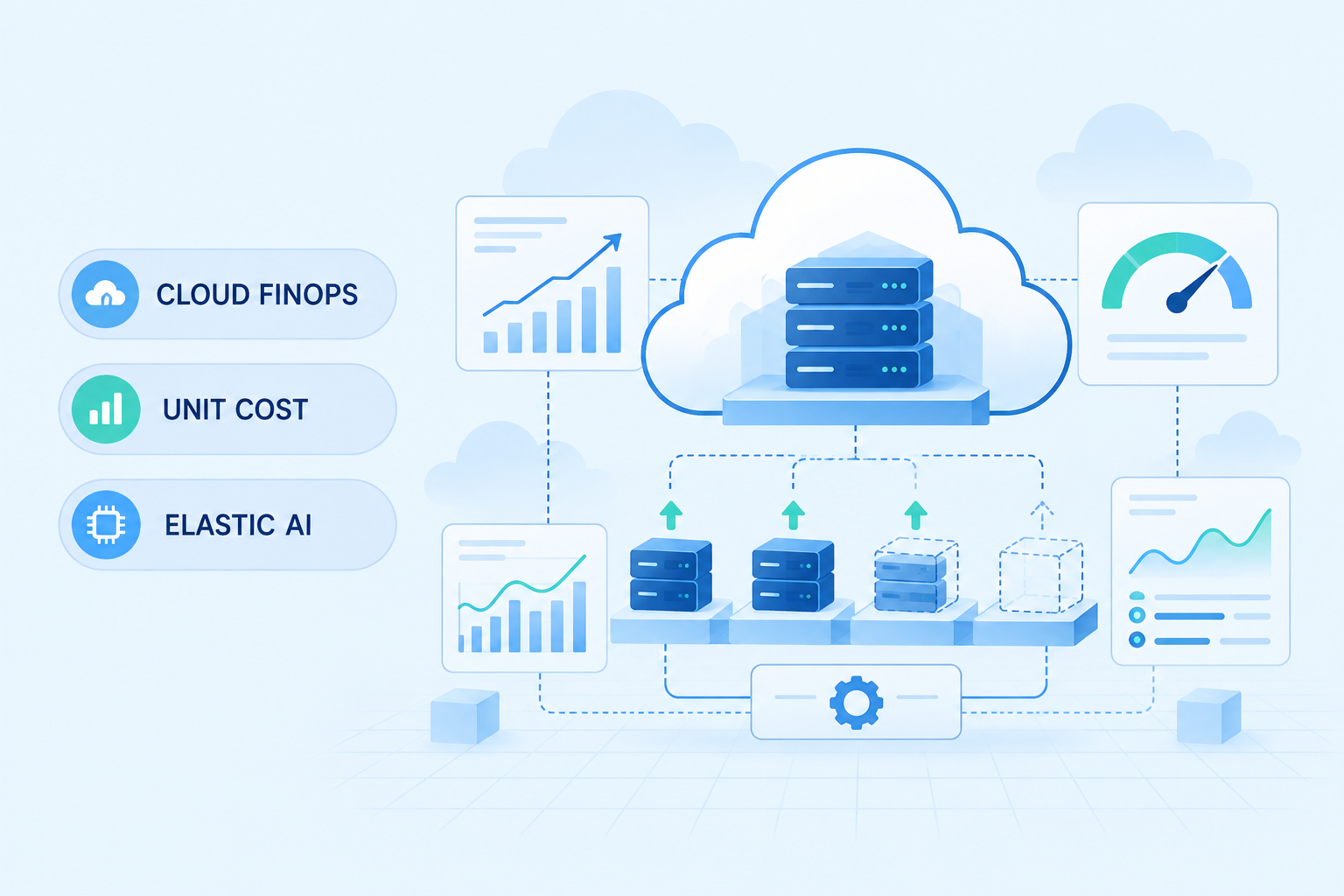
AI infrastructure makes familiar cloud cost problems more visible. Demand can be bursty, accelerators may be scarce, idle capacity is expensive, and one product feature can trigger thousands of model or tool calls. A monthly cost-reduction target is too blunt for this environment. Teams need to understand what each useful outcome costs and how capacity choices affect reliability.
FinOps provides the collaboration model: engineering, finance, and business teams make timely decisions using shared cost and value data. For AI workloads, that means moving from “How much did the cluster cost?” to “What did it cost to complete a successful task at the required quality and latency?”
Why AI workloads challenge traditional budgeting
Conventional forecasts often assume a reasonably stable relationship between users and infrastructure. Agentic systems can break that relationship. One user request may create several planning steps, retrieval calls, model invocations, sandbox jobs, and retries. A feature that appears inexpensive in a demonstration can become costly when concurrency and failure behavior are introduced.
Capacity is also heterogeneous. Different models and workloads need different accelerators, memory profiles, latency targets, and geographic placement. Reserving everything protects availability but creates idle spend. Relying entirely on on-demand capacity can expose the service to price and availability shocks.
Define the unit before optimizing
Cloud totals are useful for accounting but weak for engineering decisions. Select units that reflect delivered value: cost per completed support case, document processed, code review, forecast generated, or thousand successful API transactions. Include failed attempts and retries in the denominator analysis; excluding them hides operational waste.
Pair cost with quality and service measures. A cheaper model is not an optimization if it reduces task completion enough to create rework. A smaller cluster is not efficient if it violates a customer-facing latency objective. The target is acceptable quality and reliability at a sustainable unit cost.
Tag and allocate the complete workload
Model inference may be the visible expense, but a production AI service also uses vector storage, databases, observability, network transfer, caches, batch preparation, security controls, and idle failover capacity. Establish consistent allocation dimensions such as product, environment, team, model, region, and customer segment.
Shared platform costs should follow a documented allocation rule. Perfect precision is less important than consistency and transparency. If teams cannot see the cost they influence, accountability becomes a slogan rather than an operating practice.
Use a capacity portfolio
A resilient design combines capacity types. Reserve a baseline for steady, critical demand; use elastic capacity for bursts; use interruptible resources for checkpointed batch work; and define fallback options for constrained regions or accelerator types. Each workload should have an explicit priority, preemption policy, and degraded mode.
Dynamic scheduling works best when applications expose real requirements rather than requesting the largest available machine. Record memory, accelerator, locality, deadline, and interruption tolerance. A scheduler can then place work efficiently instead of treating every job as mission critical.
Put guardrails close to consumption
Budgets and alerts are necessary but often arrive after waste has occurred. Add runtime controls: per-project quotas, concurrency limits, maximum agent steps, model-routing policies, cache rules, timeouts, and circuit breakers. For experimental environments, use automatic expiration and low default limits. For production, link limits to service tiers and business priorities.
Guardrails should fail predictably. A spend cap that abruptly stops a critical process can turn a cost issue into an availability incident. Define whether the system should queue work, switch models, reduce context, return a limited result, or request approval.
Optimize the application before negotiating rates
Commitment discounts can reduce price, but they can also lock in an inefficient architecture. First remove unnecessary work. Shorten oversized prompts, retrieve less irrelevant context, batch compatible requests, cache stable results, prevent unbounded retries, and route simple tasks to appropriately capable models.
Then right-size infrastructure using observed utilization. Evaluate managed and serverless services using total cost of ownership, including patching, scaling, operational staffing, and incident burden. A lower compute rate is not always cheaper when management overhead is included.
Run a continuous optimization loop
Establish a weekly engineering review for anomalies and a monthly cross-functional review for trends. Compare actual unit cost with targets, explain major changes, assign actions, and record the expected benefit. Verify savings after implementation; estimated savings are not realized savings.
Maintain an optimization backlog alongside product work. Rank items by value, effort, risk, and confidence. Examples include changing a storage tier, reducing logging volume, tuning autoscaling, introducing semantic caching, consolidating low-utilization clusters, or renegotiating a commitment after demand becomes predictable.
A practical scorecard
A useful dashboard includes total and allocated cost, unit cost, successful task rate, latency percentiles, accelerator utilization, idle capacity, cache hit rate, retry rate, fallback frequency, and forecast variance. Business owners should be able to see whether increased spending represents healthy growth or deteriorating efficiency.
The takeaway
FinOps for AI is not a finance-led campaign to shrink the bill. It is a shared system for connecting architecture, capacity, product value, and risk. Define meaningful units, allocate the full workload, combine baseline and elastic capacity, enforce safe guardrails, and optimize continuously. The result is infrastructure that can absorb variable demand without turning every successful product launch into a cost surprise.
Sources
- Google Cloud: Dynamic capacity management for AI infrastructure
- Google Cloud Well-Architected Framework: Cost optimization
- FinOps Foundation: FinOps Framework 2025
Build it with Cogniquaint experts
Cogniquaint helps cloud and finance teams create a shared view of AI infrastructure value. Our in-house experts can map end-to-end cost drivers, define meaningful unit economics, tune elastic capacity, introduce safe consumption guardrails, and build an optimization cadence that protects performance while improving spend efficiency.
Work with Cogniquaint
Ready to elevate your operations with AI-powered insights?
Get in touch with us to build your next intelligent solution.
