
ERP knows what the business intends to produce, purchase, consume, and ship. Factory systems know what is happening to machines, materials, people, and batches now. Operations become difficult when those worlds communicate through delayed spreadsheets, fragile point-to-point interfaces, or ambiguous status codes. Planners see yesterday’s reality, supervisors re-enter data, and finance spends time reconciling quantities after the fact.
The practical goal is not to send every IoT reading into ERP. It is to convert production reality into trustworthy business events and to deliver planning intent to manufacturing systems with clear ownership. This gives teams convenience where it matters: fewer manual handoffs, faster exception handling, better traceability, and a shared view of the order lifecycle.
Use ISA-95 to clarify responsibilities
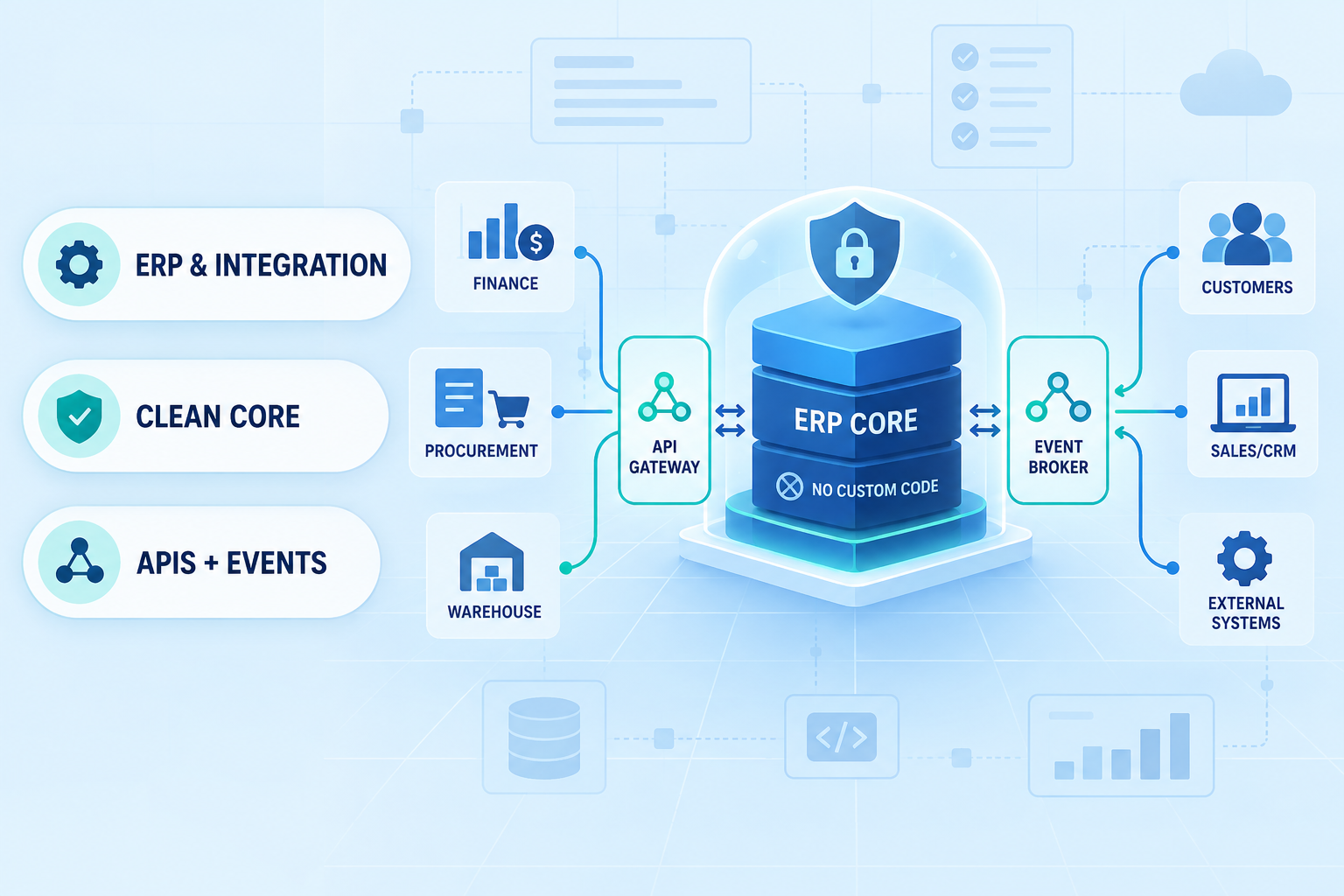
ISA-95 provides a technology-neutral framework for the boundary between manufacturing operations and enterprise functions. Its levels distinguish physical processes, sensing and control, manufacturing operations management such as MES, and business planning and logistics such as ERP. The framework helps IT and operations teams agree on activities, objects, and information exchanges without prescribing one vendor stack.
Use that boundary to decide the system of record. ERP may own the production order, planned quantity, material requirements, and financial valuation. MES or another operations platform may own dispatch, detailed execution, actual start and finish, genealogy, quality results, and equipment context. IoT and control systems provide timely evidence, but a governed operations service should translate that evidence into business meaning.
Model events around business facts
Useful events are named in the past tense because they describe facts: ProductionOrderReleased, OperationStarted, MaterialConsumed, InspectionCompleted, QuantityConfirmed, DowntimeRecorded, or BatchCompleted. Each event should carry a stable event ID, event type and version, event time, producer, plant, order and operation identifiers, material or batch references, quantity and unit, relevant asset context, and trace information.
Do not publish a generic status-updated message and require every consumer to infer meaning from a code. Keep payloads focused, document semantics, and evolve schemas compatibly. Protect sensitive or regulated fields and avoid placing unnecessary personal data in widely distributed events.
A realistic plan-to-production flow
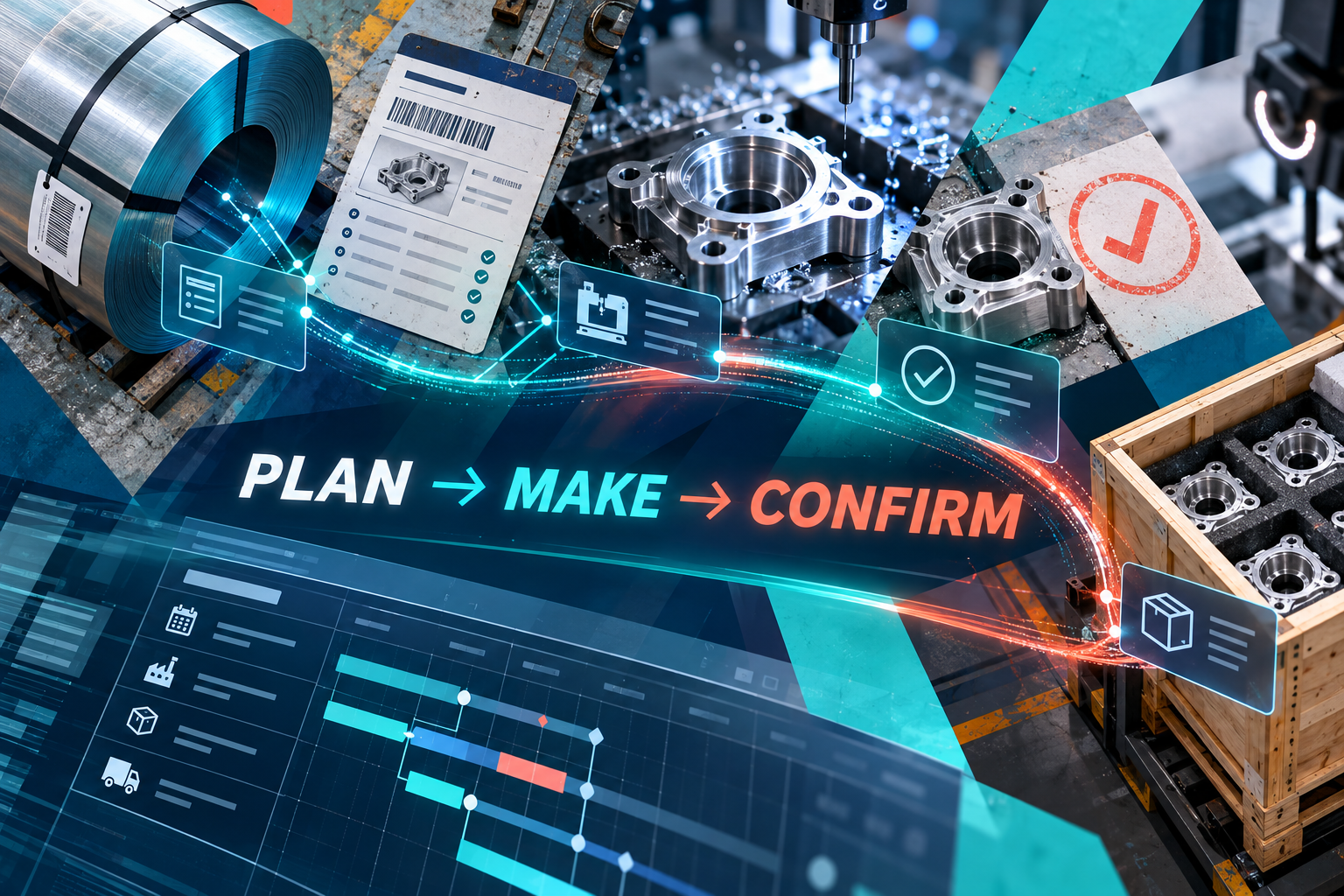
Consider a metal-components factory. ERP releases an order for a defined quantity and due date. An integration service validates the master-data references and delivers the order intent to MES. The supervisor dispatches the first operation. Machines and IoT sensors provide cycle, condition, and count signals, but MES applies routing, quality, and operator context before declaring a completed quantity.
When inspection passes, MES publishes InspectionCompleted and QuantityConfirmed events. Inventory consumes the confirmation idempotently, planning updates progress, the warehouse prepares downstream movement, and analytics updates throughput. If a dimensional check fails, a QualityHoldPlaced event prevents an optimistic inventory update and routes an exception to the responsible team. The operator records the disposition once instead of repeating it in several systems.
This is how AI and IoT support smoother ERP operations. IoT captures the process evidence. AI can detect an unusual quality pattern, rank likely contributing conditions, or recommend inspection. The approved operational workflow decides whether to hold material or change the plan. ERP receives a governed business outcome, not an unexplained model score or a flood of sensor values.
Choose synchronous and asynchronous paths deliberately
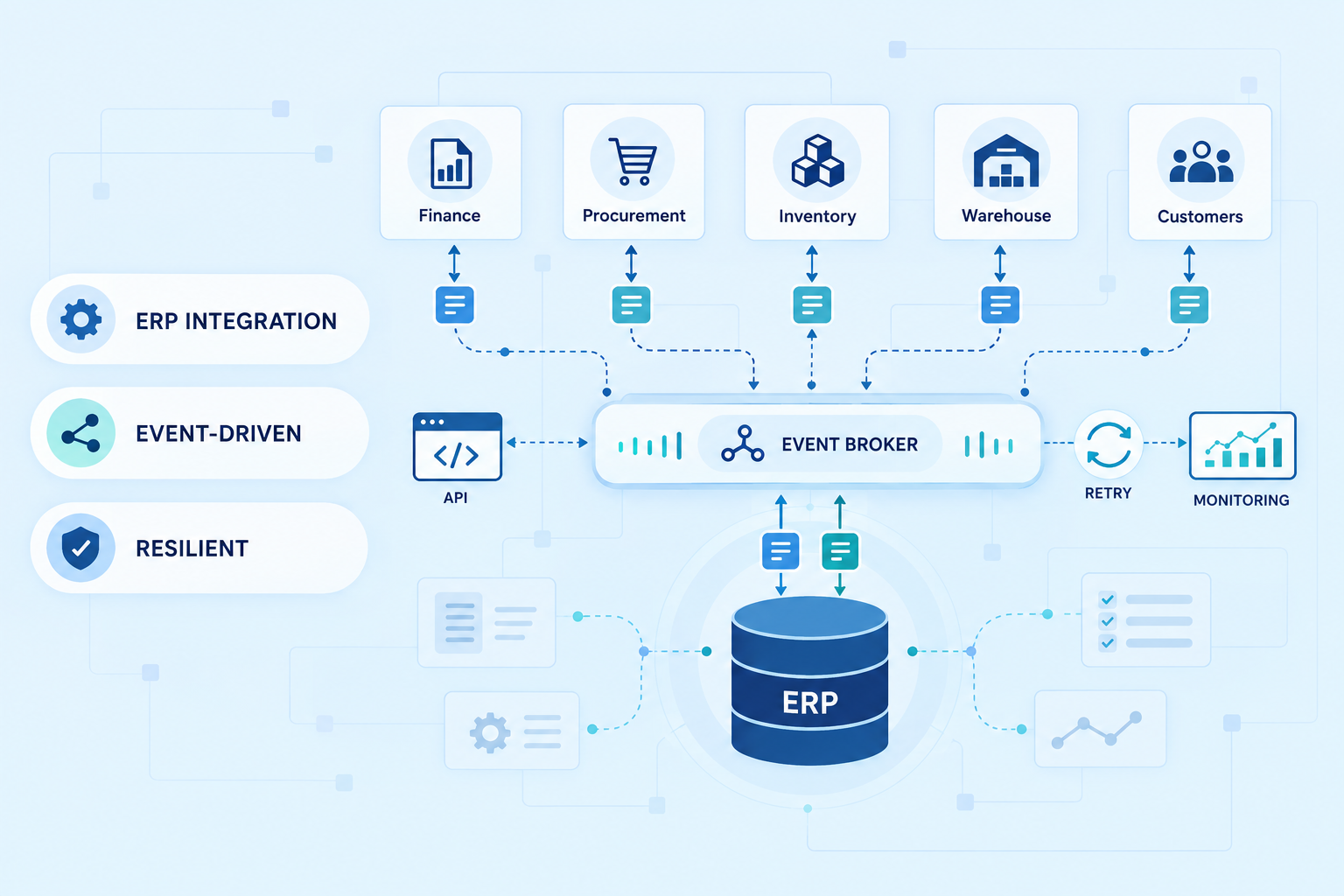
Some interactions need an immediate response, such as validating a material or retrieving an approved specification. Others are naturally event-driven, especially when several consumers need the same production fact. Microsoft describes event-driven architecture as producers emitting events through channels to decoupled consumers, with publish-subscribe and durable event-stream variants. The same guidance highlights challenges such as delivery, error handling, ordering, and eventual consistency.
Use queues or durable streams where buffering and replay matter. Partition events by a key that preserves the ordering required for an order, batch, or asset. Make consumers idempotent because retries can occur. Put irrecoverable messages in a dead-letter path with ownership, diagnostics, and a safe replay procedure. Do not claim exactly-once business processing simply because a broker offers a delivery feature; protect the receiving transaction with deduplication and state checks.
Design for reconciliation
Eventual consistency is acceptable only when the business understands the delay and exceptions are visible. Maintain correlation identifiers from order release through confirmation. Create reconciliation views that compare ERP orders, MES execution, quality disposition, and inventory postings. Alert on stuck transitions, missing confirmations, duplicate quantities, invalid master-data references, and events that exceed an agreed age.
Provide compensating actions rather than editing history invisibly. If a production confirmation was wrong, publish a controlled correction linked to the original. Preserve who approved it and why. Traceability matters for operational learning, audit, and financial confidence.
Roll out by value stream
Begin with one product family or line and a narrow event vocabulary. Map the current manual steps, establish ownership for each object, test failure and replay, and train the people who handle exceptions. Track confirmation latency, manual entries per order, reconciliation exceptions, inventory accuracy, order-status freshness, and time to resolve a hold.
Expand after the first flow is stable. Reuse common envelope fields and platform controls, but allow domain-specific payloads. A plant’s batch genealogy is not the same as a warehouse movement, even when both use the same event infrastructure.
Successful ERP–factory integration respects both planning and production reality. When each business fact is explicit, traceable, and safe to replay, teams spend less time chasing interfaces and more time improving the operation.
Sources
- ISA — ISA-95 enterprise-control integration standard
- Microsoft Learn — Event-driven architecture style
Build it with Cogniquaint experts
Cogniquaint’s ERP, MES, IoT, and integration experts can work alongside business and plant teams to map ISA-95 responsibilities, define production-event contracts, implement resilient APIs and messaging, and establish reconciliation and observability that keep planning and execution aligned.
Work with Cogniquaint
Ready to elevate your operations with AI-powered insights?
Get in touch with us to build your next intelligent solution.