

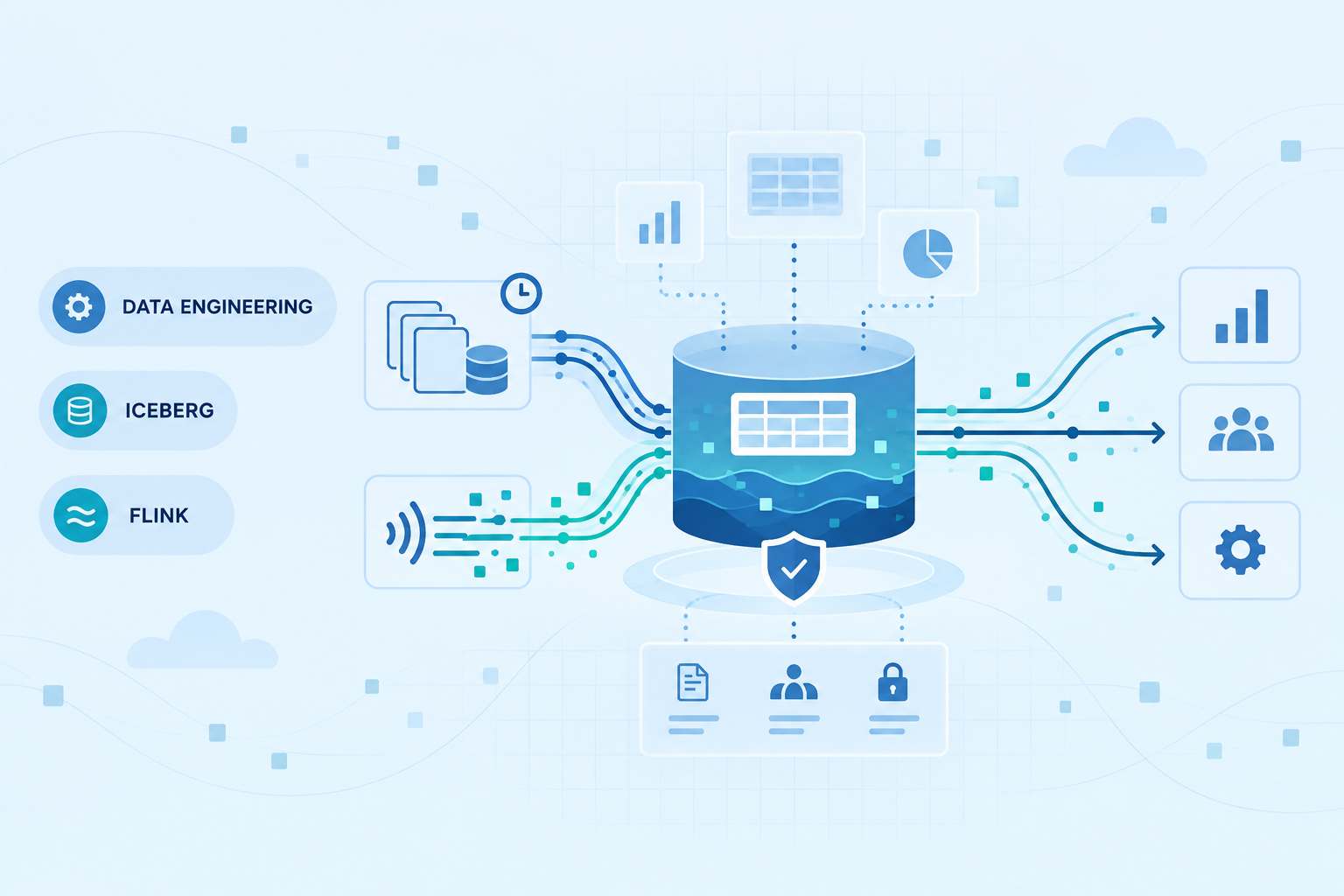
Many data platforms evolve into two parallel systems. A batch pipeline writes curated data to a lake or warehouse, while a streaming pipeline independently transforms the same business events for dashboards, alerts, or operational applications. The split can reduce latency, but it also creates duplicated logic, mismatched schemas, separate recovery procedures, and a permanent reconciliation problem.
A more maintainable pattern is emerging around open table formats. Apache Iceberg provides a transactional table layer on object storage, while Apache Flink can process new Iceberg snapshots incrementally. Instead of treating the data lake as a destination that becomes useful only after a batch completes, teams can use it as the shared system of record for both historical and near-real-time processing.
Why duplicated pipelines become expensive
Separate batch and streaming paths rarely remain equivalent. A business rule is corrected in one codebase but not the other. The batch job uses a new customer identifier while the streaming job still joins on an older key. Backfills are straightforward in the batch system but awkward in a broker-first stream. Operations teams must monitor two delivery paths, and consumers need to decide which output is authoritative.
The engineering cost is not limited to infrastructure. Every schema change, access-control decision, quality check, and incident procedure must be implemented twice. When numbers disagree, teams spend time tracing lineage rather than delivering new capability.
The shared-table approach
Iceberg manages data files as tables with snapshots and atomic commits. Writers can add or update data without exposing a partially committed table state to readers. Schema evolution, partition evolution, time travel, and rollback provide controls that plain folders of files do not.
Flink can monitor the table for new snapshots and process only the files introduced after its last checkpoint. The table remains available to batch engines and SQL query services, while the incremental consumer handles low-latency use cases. This does not make every workload “real time.” It gives the platform one governed storage layer with multiple consumption speeds.
A typical flow has source events land in object storage, an ingestion service commit them to Iceberg, a catalog hold table metadata, and Flink consume incremental changes. Historical jobs, ad hoc SQL, machine-learning preparation, and streaming transformations can all work from the same table state.
Where the pattern fits
This architecture is useful when data is queried repeatedly soon after arrival: fraud indicators, customer-profile changes, operational dashboards, inventory signals, or downstream event triggers. It is less compelling for data processed once per day with no urgency. Continuous streaming compute has an ongoing cost, and a simple scheduled batch can still be the better engineering decision.
The key design question is not “Can we stream this?” It is “What decision becomes better when this data arrives sooner?” A measurable freshness objective should determine polling intervals, checkpoint frequency, and compute capacity.
Design controls that matter
1. Define commit and freshness semantics
Document when a record is considered available. Consumers should understand whether they see append-only events, corrected records, or the latest materialized state. Track both source-event time and ingestion time so late arrivals can be measured rather than hidden.
2. Treat checkpointing as a correctness feature
Checkpoint configuration affects recovery, duplicate processing, and cost. Test failure during writes and reads, not just clean restarts. Exactly-once claims should be verified against the complete path, including external sinks that may not share Flink’s transactional boundary.
3. Govern schema evolution
Iceberg can evolve schemas safely, but compatibility is still a contract. Classify changes as additive, compatible, or breaking. Validate new fields with representative consumers before production rollout, and give owners a clear deprecation process.
4. Plan table maintenance
Frequent commits can produce many small files and metadata objects. Compaction, snapshot expiration, orphan-file cleanup, and manifest maintenance belong in the operating model. Without them, a correct design can gradually become slow and expensive.
5. Secure every processing identity
The streaming application, catalog, storage layer, and query engines should use narrowly scoped identities. Encrypt data in transit and at rest, classify sensitive fields, and prevent a general-purpose processing role from gaining broad access to unrelated tables.
A sensible adoption path
Begin with one observable use case such as a live operational dashboard. Establish a baseline for freshness, throughput, query performance, recovery time, and cost. Run the unified path beside the existing solution long enough to compare record counts and business aggregates. Introduce failure tests, schema changes, and a controlled backfill before cutover.
After the first workload is stable, extract reusable components: table-creation standards, catalog conventions, Flink deployment templates, quality checks, alerts, and maintenance jobs. A platform pattern creates value only when the second and third pipeline become easier than the first.
The takeaway
Iceberg and Flink can reduce the architectural tax of maintaining separate batch and streaming estates. The strongest benefit is not a particular service or latency number; it is a shared, transactional data foundation with consistent governance and recovery. Use streaming where freshness changes an outcome, preserve batch where it remains economical, and make both modes operate on the same trusted table state.
Sources
- AWS: Building unified data pipelines with Apache Iceberg and Apache Flink
- AWS: Streaming real-time data into Apache Iceberg tables
Build it with Cogniquaint experts
Cogniquaint helps data teams turn this architecture into an operating platform. Our in-house experts work alongside your engineers to assess the current data estate, design the target lakehouse and streaming pattern, establish governance and observability, and deliver a production-ready pilot that your team can extend confidently.
Work with Cogniquaint
Ready to elevate your operations with AI-powered insights?
Get in touch with us to build your next intelligent solution.
